Fee Download Whose Justice? Which Rationality?, by Alasdair MacIntyre
Whose Justice? Which Rationality?, By Alasdair MacIntyre. Checking out makes you better. That claims? Numerous smart words say that by reading, your life will be better. Do you think it? Yeah, prove it. If you need the book Whose Justice? Which Rationality?, By Alasdair MacIntyre to review to prove the smart words, you could visit this page completely. This is the website that will supply all guides that probably you need. Are guide's collections that will make you really feel interested to read? One of them below is the Whose Justice? Which Rationality?, By Alasdair MacIntyre that we will propose.
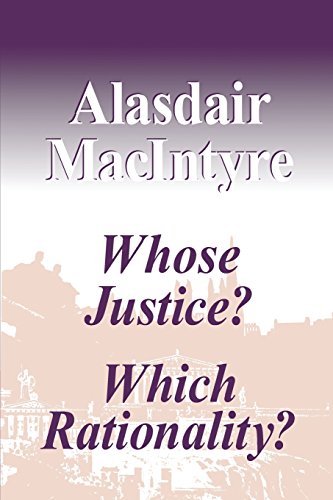
Whose Justice? Which Rationality?, by Alasdair MacIntyre

Fee Download Whose Justice? Which Rationality?, by Alasdair MacIntyre
Whose Justice? Which Rationality?, By Alasdair MacIntyre. Accompany us to be member right here. This is the website that will give you alleviate of browsing book Whose Justice? Which Rationality?, By Alasdair MacIntyre to review. This is not as the various other site; the books will be in the types of soft documents. What benefits of you to be participant of this site? Obtain hundred compilations of book link to download and install and also obtain constantly upgraded book daily. As one of guides we will present to you currently is the Whose Justice? Which Rationality?, By Alasdair MacIntyre that comes with a quite completely satisfied idea.
Well, publication Whose Justice? Which Rationality?, By Alasdair MacIntyre will make you closer to just what you are willing. This Whose Justice? Which Rationality?, By Alasdair MacIntyre will be always good buddy whenever. You may not forcedly to always finish over reviewing an e-book in other words time. It will be only when you have extra time and also spending few time to make you feel enjoyment with exactly what you review. So, you can get the meaning of the notification from each sentence in the book.
Do you recognize why you should review this website and just what the relationship to checking out publication Whose Justice? Which Rationality?, By Alasdair MacIntyre In this contemporary period, there are lots of means to obtain the publication and they will be a lot easier to do. One of them is by getting the publication Whose Justice? Which Rationality?, By Alasdair MacIntyre by on-line as just what we tell in the link download. Guide Whose Justice? Which Rationality?, By Alasdair MacIntyre can be a choice because it is so correct to your need now. To obtain guide online is quite easy by simply downloading them. With this opportunity, you could review the book any place as well as whenever you are. When taking a train, waiting for listing, as well as waiting for somebody or other, you can read this online publication Whose Justice? Which Rationality?, By Alasdair MacIntyre as a great pal once again.
Yeah, reading a publication Whose Justice? Which Rationality?, By Alasdair MacIntyre could add your pals lists. This is one of the formulas for you to be effective. As understood, success does not imply that you have wonderful things. Understanding as well as knowing even more compared to various other will certainly offer each success. Beside, the notification and also impression of this Whose Justice? Which Rationality?, By Alasdair MacIntyre could be taken and selected to act.
Whose Justice? Which Rationality?, the sequel to After Virtue, is a persuasive argument of there not being rationality that is not the rationality of some tradition. MacIntyre examines the problems presented by the existence of rival traditions of inquiry in the cases of four major philosophers: Aristotle, Augustine, Aquinas, and Hume.
- Sales Rank: #373528 in Books
- Published on: 1989-12-31
- Original language: English
- Number of items: 1
- Dimensions: 9.00" h x 1.30" w x 6.00" l, 1.36 pounds
- Binding: Paperback
- 432 pages
From Publishers Weekly
Is there any cause or war worth risking one's life for? How can we determine which actions are vices and which virtues? MacIntyre, professor of philosophy at Vanderbilt University, unravels these and other such questions by linking the concept of justice to what he calls practical rationality. He rejects the grab-what-you-can, utilitarian yardstick adopted by moral relativists. Instead, he argues that four wholly different, incompatible ideas of justiceput forth by Aristotle, Augustine, Aquinas and Humehave helped shape our modern individualistic world. In his unorthodox view, each person seeks the good through an ongoing dialogue with one of these traditions or within Jewish, non-Western or other historical traditions. This weighty sequel to After Virtue (1981) is certain to stir debate.
Copyright 1988 Reed Business Information, Inc.
From Library Journal
In this sequel to After Virtue ( LJ 9/15/81), MacIntyre contends that any rational justification of moral judgments must presuppose some particular tradition's conception of rationality. He illustrates his contention by examining four philosophersAristotle, Augustine, Aquinas, and Humeto show how their different views about justice and practical rationality derive from different sources. MacIntyre asserts that although a tradition may fail by its own standards, the answer to any question about justice depends upon the historical, social, and cultural situation of the respondent and upon how he sees himself. The book's historical analyses are clear and stimulating, but the arguments for its own thesis are cloudy and ineffectual.Robert Hoffman, York Coll., CUNY
Copyright 1988 Reed Business Information, Inc.
Review
“MacIntyre is widely informed and his story of developments in the traditions that he identifies is learned, interesting, and notably well-written.” —London Review of Books
“Alasdair MacIntyre has done it again. Here [he] delivers on his promise in After Virtue to develop an account of rationality and justice that is tradition specific. . . . What is so remarkable about MacIntyre’s achievement is his ability to combine close historical analysis with philosophical argumentation while never losing his narrative line. . . . His analysis illumines our situation in an extraordinary manner.” —Commonweal
“MacIntyre is a master of the history of ideas. . . . [He] helps us to understand why so many people are stymied today in articulating beliefs that underlie their traditions of inquiry, practice, and public discourse.” —Commentary
“[MacIntyre’s] diagnosis of what ails recent moral philosophy is brilliant.” —Wilson Quarterly
“MacIntyre’s rich historical exposition displays all the erudition and philosophical subtlety that his readers have come to expect from his work. . . . [T]here is much to admire in MacIntyre’s unflinching indictment of liberal modernity.” —The New Criterion
Most helpful customer reviews
3 of 4 people found the following review helpful.
Read "After Virtue" first, then...
By EJTV
I didn't find this book as engaging as "After Virtue." If you have not read "After Virtue," I would start there first, and then move to "Three Rival Versions of Moral Inquiry" and then to "Dependent Rational Animals." If you want more, then move to "Whose Justice? Which Rationality?" My bias is classical liberal, pro-market and anti-state, but always with tension with a more communitarian/Thomistic approach which MacIntyre gives. He does not get economics, however, and true to his Marxist roots, for example, he indicates that Aquinas "held a version of the labor theory of value," that the Summa to support that "exorbitant prices" are theft, that capitalism is incompatible with St. Thomas, in pp.199-200. In truth, Aquinas has a rudimentary understanding of prices as being the result of the subjective value of the buyer, an idea later fully developed by his followers, the Late Scholastics of Salamanca. Still, you will find great Thomistic nuggets in "Whose Justice? Which Rationality?"
0 of 6 people found the following review helpful.
Whose Justice Which Reality
By A Customer
Excellent, must read follow up to After Virtue. Adding another twenty required words to this review will not make either the review or the book any better than it already is.
95 of 98 people found the following review helpful.
A major work of contemporary philosophy
By Kindle Customer
This is a review of _Whose Justice? Which Rationality?_ by Alasdair MacIntyre.
This is a very challenging book to read, but also one that will deepen your thinking about the world, whether you agree with it or not.
We largely take it for granted that (1) people disagree significantly about a wide range of issues related to ethics, and that (2) people do not agree about enough standards of rationality to resolve these ethical disagreements. MacIntyre puts this by saying that "logical incompatibility and incommensurability" both obtain (p. 351). What conclusion should we draw from these facts? One common response is relativism, which is roughly the view that the truth or falsity of a claim depends on the perspective from which it is evaluated. However, MacIntyre argues against relativism based on a brilliant reinterpretation of several major Western philosophical traditions.
The Western Englightenment (of which Descartes is paradigmatic), rejected appeals to tradition, canonical texts and authority, and attempted to put in their place the "appeal to principles undeniable by any rational person," and hence independent of culture, history, etc. "Yet both the thinkers of the Enlightenment and their successors proved unable to agree as to what precisely those principles were which could be found undeniable by all rational persons" (p. 6). Since the Enlightenment, most Western thinkers have either (1) continued to search for principles that are universally acceptable to all minimally rational humans (and continued to fail in this quest), or (2) given up on the quest for universal principles of reason, but -- paradoxically -- continued to assume the Enlightenment prejudice that any rational justification would have to be universal, ahistorical, and acultural.
MacIntyre suggests that neither approach has learned the lesson of the failure of the Enlightenment project, which is that any rational justification has to be parochial, historical and in a particular cultural context.
Since rational justification must be historical, the bearers of justification are not "theories" in the abstract, but embodied traditions. MacIntyre examines four sample traditions in this book (although he admits there are many more): the Aristotelian-Thomistic, the Augustinean, and those of the "Scottish Enlightenment" and modern liberalism.
Traditions like these can undergo "epistemological crises": situations in which a tradition, by its own standards, increasingly discloses "new inadequacies, hitherto unrecognized incoherences, and new problems for the solution of which there seem to be insufficient or no resources within the established fabric of belief" (p. 362). A tradition may find a way to survive such a crisis (as Thomas Aquinas helped Christianity to do by synthesizing Augustineanism and Aristotelianism), but it may also fail. And because the possibility of failure is there, relativism is false: a tradition can come to see that its claims are false even by its own standards.
Even if my tradition is not in an obvious crisis, I can realize that I have a rational justification for rejecting or modifying it. Suppose I am confronted with an alien intellectual tradition which is both incompatible and incommensurable with my own. Because the two are incompatible, I cannot simply agree with both traditions. But because of incommensurability, I cannot directly convince the adherents of the rival tradition that they are wrong (nor can they directly convince me). I can, however, learn to be "bilingual" in the two traditions. The Aristotelian can learn, for example, to "speak Confucian," as it were. Having done so, he occupies a special perspective, from which he may conclude that the Confucian worldview offers a superior interpretation of the strengths and weaknesses of his own tradition. Or he may conclude the opposite. Or he may conclude that some sort of synthesis is possible, which is superior to either one individually. For this reason also, relativism is not true, despite the fact that traditions are, when speaking one to the other, incommensurable: someone occupying one tradition *can* see that his views are fundamentally mistaken.
MacIntyre argues that, of the four traditions he considers in this book, three have entered inescapable epistemological crises, while one (the tradition of Thomas Aquinas) has answered all challenges so far. The bulk of the book is a history of the four traditions. If you want to get the outline of MacIntyre's view, I recommend chapters 1 (the intro), 7-8 (on Aristotle), 9 (on Augustine), 10-11 (on Aquinas's synthesis), 16 (on Hume), 17 (on liberalism), and 18-20 (MacIntyre's grand theory).
This is, of course, an easier book to read if you have read some previous philosophy (Thomas Kuhn's _The Structure of Scientific Revolutions_ is in the background of much of what MacIntyre says, even though he doesn't cite Kuhn very often), but a bright, motivated non-philosopher can read and greatly enjoy this book too.
Whose Justice? Which Rationality?, by Alasdair MacIntyre PDF
Whose Justice? Which Rationality?, by Alasdair MacIntyre EPub
Whose Justice? Which Rationality?, by Alasdair MacIntyre Doc
Whose Justice? Which Rationality?, by Alasdair MacIntyre iBooks
Whose Justice? Which Rationality?, by Alasdair MacIntyre rtf
Whose Justice? Which Rationality?, by Alasdair MacIntyre Mobipocket
Whose Justice? Which Rationality?, by Alasdair MacIntyre Kindle

Tidak ada komentar:
Posting Komentar