PDF Ebook The Fourth Revolution: The Global Race to Reinvent the State, by Adrian Wooldridge,John Micklethwait,Adrian Wooldridge, John Micklethwait
Idea in selecting the best book The Fourth Revolution: The Global Race To Reinvent The State, By Adrian Wooldridge,John Micklethwait,Adrian Wooldridge, John Micklethwait to read this day can be gained by reading this web page. You could discover the best book The Fourth Revolution: The Global Race To Reinvent The State, By Adrian Wooldridge,John Micklethwait,Adrian Wooldridge, John Micklethwait that is offered in this globe. Not only had the books published from this country, yet likewise the various other countries. And currently, we suppose you to check out The Fourth Revolution: The Global Race To Reinvent The State, By Adrian Wooldridge,John Micklethwait,Adrian Wooldridge, John Micklethwait as one of the reading materials. This is only one of the best books to collect in this website. Consider the page and search the books The Fourth Revolution: The Global Race To Reinvent The State, By Adrian Wooldridge,John Micklethwait,Adrian Wooldridge, John Micklethwait You could find great deals of titles of guides supplied.
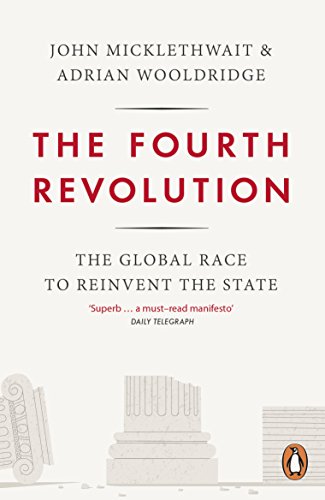
The Fourth Revolution: The Global Race to Reinvent the State, by Adrian Wooldridge,John Micklethwait,Adrian Wooldridge, John Micklethwait

PDF Ebook The Fourth Revolution: The Global Race to Reinvent the State, by Adrian Wooldridge,John Micklethwait,Adrian Wooldridge, John Micklethwait
Imagine that you get such certain incredible experience and also understanding by only reading an e-book The Fourth Revolution: The Global Race To Reinvent The State, By Adrian Wooldridge,John Micklethwait,Adrian Wooldridge, John Micklethwait. How can? It seems to be higher when a publication could be the finest thing to discover. Books now will appear in printed and soft data collection. One of them is this e-book The Fourth Revolution: The Global Race To Reinvent The State, By Adrian Wooldridge,John Micklethwait,Adrian Wooldridge, John Micklethwait It is so normal with the printed e-books. Nonetheless, lots of people sometimes have no area to bring the book for them; this is why they cannot review guide anywhere they really want.
As understood, experience and encounter regarding session, entertainment, as well as knowledge can be gained by just checking out a publication The Fourth Revolution: The Global Race To Reinvent The State, By Adrian Wooldridge,John Micklethwait,Adrian Wooldridge, John Micklethwait Even it is not straight done, you could know even more about this life, regarding the world. We provide you this proper and very easy way to gain those all. We provide The Fourth Revolution: The Global Race To Reinvent The State, By Adrian Wooldridge,John Micklethwait,Adrian Wooldridge, John Micklethwait and also numerous book collections from fictions to scientific research whatsoever. Among them is this The Fourth Revolution: The Global Race To Reinvent The State, By Adrian Wooldridge,John Micklethwait,Adrian Wooldridge, John Micklethwait that can be your partner.
Just what should you assume more? Time to get this The Fourth Revolution: The Global Race To Reinvent The State, By Adrian Wooldridge,John Micklethwait,Adrian Wooldridge, John Micklethwait It is simple then. You could only rest and stay in your place to get this book The Fourth Revolution: The Global Race To Reinvent The State, By Adrian Wooldridge,John Micklethwait,Adrian Wooldridge, John Micklethwait Why? It is on the internet publication store that offer numerous compilations of the referred books. So, just with web link, you can delight in downloading this book The Fourth Revolution: The Global Race To Reinvent The State, By Adrian Wooldridge,John Micklethwait,Adrian Wooldridge, John Micklethwait as well as varieties of books that are looked for now. By checking out the link web page download that we have offered, the book The Fourth Revolution: The Global Race To Reinvent The State, By Adrian Wooldridge,John Micklethwait,Adrian Wooldridge, John Micklethwait that you refer a lot can be discovered. Just conserve the asked for book downloaded then you could delight in guide to review whenever as well as area you really want.
It is really easy to review the book The Fourth Revolution: The Global Race To Reinvent The State, By Adrian Wooldridge,John Micklethwait,Adrian Wooldridge, John Micklethwait in soft data in your gizmo or computer system. Once more, why ought to be so challenging to obtain guide The Fourth Revolution: The Global Race To Reinvent The State, By Adrian Wooldridge,John Micklethwait,Adrian Wooldridge, John Micklethwait if you can pick the less complicated one? This web site will certainly relieve you to pick as well as decide on the very best collective publications from one of the most ideal vendor to the released publication lately. It will always upgrade the compilations time to time. So, link to internet as well as visit this site constantly to obtain the brand-new publication on a daily basis. Currently, this The Fourth Revolution: The Global Race To Reinvent The State, By Adrian Wooldridge,John Micklethwait,Adrian Wooldridge, John Micklethwait is all yours.
From the bestselling authors of The Right Nation, a visionary�argument that our current crisis in government is nothing less than the�fourth radical transition in the history of the nation-state
Dysfunctional government: It’s become a clich�,�and most of us are resigned to the fact that nothing�is ever going to change. As John Micklethwait and�Adrian Wooldridge show us, that is a seriously�limited view of things. In fact, there have been�three great revolutions in government in the�history of the modern world. The West has led these�revolutions, but now we are in the midst of a fourth�revolution, and it is Western government that is in�danger of being left behind.
Now, things really are different. The West’s debt�load is unsustainable. The developing world has�harvested the low-hanging fruits. Industrialization�has transformed all the peasant economies it had�left to transform, and the toxic side effects of rapid�developing world growth are adding to the bill.�From Washington to Detroit, from Brasilia to New�Delhi, there is a dual crisis of political legitimacy and�political effectiveness.
The Fourth Revolution crystallizes the scope of the�crisis and points forward to our future. The authors�enjoy extraordinary access to influential figures and�forces the world over, and the book is a global tour�of the innovators in how power is to be wielded.�The age of big government is over; the age of smart�government has begun. Many of the ideas the�authors discuss seem outlandish now, but the center�of gravity is moving quickly.
This tour drives home a powerful argument:�that countries’ success depends overwhelmingly on�their ability to reinvent the state. And that much�of the West—and particularly the United States—is failing badly in its task. China is making rapid�progress with government reform at the same time�as America is falling badly behind. Washington is�gridlocked, and America is in danger of squandering�its huge advantages from its powerful economy�because of failing government. And flailing�democracies like India look enviously at China’s�state-of-the-art airports and expanding universities.
The race to get government right is not just a�race of efficiency. It is a race to see which political�values will triumph in the twenty-first century—the liberal values of democracy and liberty or the�authoritarian values of command and control. The�stakes could not be higher.
- Sales Rank: #11639353 in Books
- Published on: 2015-06-18
- Original language: English
- Number of items: 1
- Dimensions: 7.80" h x .75" w x 5.08" l, .55 pounds
- Binding: Paperback
Most helpful customer reviews
4 of 4 people found the following review helpful.
A revolution or continuation of the ideas of Milton Friedman?
By Trevor Neal
John Micklethwait and Adrian Wooldridge's book 'The Fourth Revolution: The Global Race to reinvent the State' has some expansive ambitions. Claiming that government has become too bloated and inefficient, the authors seek nothing less than to reform it, advocating for leaner more effective governments. Comparing Western governments to East Asian governments such as Singapore, and China, they feel that the west is losing ground to the east in the race to make government leaner and more effective.
The book is titled the 'fourth revolution' because the authors believe that we have had 3 and a half revolutions before our current stage. As another reviewer on Amazon pointed out, the first revolution was brought about by Thomas Hobbes, through his idea of a contract between government and the people. The two revolutions that most impact our current age, are the rise of the welfare state linked to the ideas of Beatrice Webb, and the influence of Milton Friedman on the policies of Reagan and Margaret Thatcher. Mr. Micklethwait and Wooldridge consider Friedman's influence to be a half revolution because the reforms did not succeed after the Clinton presidency, illustrating that government grew in size again through the presidencies of George Bush II, and Barack Obama.
Reflecting on the message of 'The Fourth Revolution,' I felt that the history lesson was the highlight of the book. I also feel the authors provided a good prognosis of the current condition that we find ourselves in. However, I was disappointed with the solutions they offered. The first point that troubles me is their need to compare. Sure, there is nothing wrong with adopting ideas from other countries if they prove effective. However, I do not like the insinuation that we should compete and that there are countries winning 'a race,' whatever this race is. Governments, like culture, and education are adapted to the specific conditions of each country.
There are specific reasons why a government managed economy is more effective in countries like Japan, China, and South Korea than in the U.S. To learn about these reasons, again one would have to delve into history. The Marshall plan that was put in place to rebuild Europe offers some good points to start reflecting on. Much of the current economic structure of the world was put in place through mechanisms such as the Marshall plan. Government managed economies allowed war-torn countries that were behind industrially to catch up. However, the question is whether managed economies will allow these same countries to have an innovative edge.
Similar arguments can be made for education. Again, countries such as South Korea may have very good test results but there are other factors that should be accounted for, these include the homogeneity of the population, and the education style. A thought for reflection, should we emphasize rote learning, or education that teaches critical thinking, and what is the best method to assess learning? These are some of the questions we should be entertaining and not whether a certain country is ahead in the learning curve just because their students are more adept at filling in bubbles on a multiple choice exam.
A reader may challenge my current line of thinking and state that I am just offering excuses to maintain the status quo. Again, I do not have qualms with the message, just in how it is delivered. The authors are thought provoking and wake their readers up to how much waste is going on in government. However, after all the 'comparisons' this was their solution: 1) cut agriculture subsidies, 2) end entitlements, 3) make tax adjustments, 4) get rid of gerrymandering, and 5) privatize certain government functions.
For such an ambitious project, diagnosing our current malaise, I didn't feel like this was much for solutions. I felt solutions offered merely advocated a continuation of Milton Friedman's revolution to cut the size of government. Certainly a lot less pages could have been devoted to getting me to this point in their argument. Yes, and maybe all the time and effort spent on 'comparing' was meant to convince me that government could be made more effective. Yet, I felt this merely weakened instead of strengthening their argument.
Still, despite all the twists and turns, and tangents that the reader is taken on, I feel there is some merit to this book. This includes the history lesson, and the diagnosis. Yes, we could be at another turning point in history, and yes, maybe changes need to be made. However, are they the changes that the authors call for?
1 of 1 people found the following review helpful.
A Prescription for Anything But "Revolution."
By Michael H. Shenkman
As a journalistic account of the various experiments in government, this book is good. Assessing the sad state of US governance, in all its aspects, it is adequate. For comprehending what contemporary governing has to accomplish it is poor. This book, as one would expect from writers of popular establishment financial magazines is still buried under 17th Century notions of Individual rights and the beneficence of market economies -- shibboleths of the now traditional right. This book provides no insight into the state of human volition in this century.
That volition has to be the concern of government: fostering the ability of humans to collaborate in the generation of productive processes that support the vitality of humans, other creatures and the earth, and do so with the awareness of what each person's actions, or more, responsibilities are for that whole. Individual rights, conceived as the right to accumulate, the right to keep what one "earns," the right to act out on one's opinions and the like, are appropriate for underpopulated, underdeveloped, limited in education populations in stable and agrarian cultures -- none of which we are today.
"Freedom," has been achieved, technologically and ideologically. We are now people who are capable and we have a wide palette on which to exercise our innate abilities. The new challenge, that government has a necessary role in promoting is "Justice," conceived as an empathetic and participatory grasp of what can be generated by means and resources available, including free human capability. This is a new requirement, in the sense of having to be operationally envisioned and accomplished and fairly (with justice as the standard) administratively accomplished. If it fails one, it fails all; if one has rights that permit the exploiting of others' rights (as does the market ideology), it fails.
Government now has three requirements: 1. Proceed intelligently; 2. Assure justice; and 3. Be trustworthy. A fourth revolution will have to envision these requirements, which these authors are barely aware of (they do envision continuing improvement and some diminishing of corruption, but have no idea of justice, as befits their ideological blinders).
2 of 2 people found the following review helpful.
Good book, but I feel that the Authors promoted the good while glossing over the bad.
By Julian Douglass
John and Adrian write a compelling book on how to reform the state, which is in much need or a redo. However, I feel that there is more to the story than the two authors lay out. When talking about teachers, for example, they sing the gospel of charter schools and private enterprise running schools, but fail to mention that a school is as only as good as the teachers who are in it. The Nordic countries have a highers standard of entry into the teaching profession than America does, which raises the quality of education. They talk down to Obamacare in the book but also sing the gospel of it in The Economist, which Micklethwait was the editor. Also, the two need to brush up on their American History, which is not only a problem in the book but in the magazine as well. Otherwise, it is a good book for serious reformers. A bitter pill for left-of-center voters like myself, but as they said in the book: The first step to solve a problem is to admit you have a problem.
The Fourth Revolution: The Global Race to Reinvent the State, by Adrian Wooldridge,John Micklethwait,Adrian Wooldridge, John Micklethwait PDF
The Fourth Revolution: The Global Race to Reinvent the State, by Adrian Wooldridge,John Micklethwait,Adrian Wooldridge, John Micklethwait EPub
The Fourth Revolution: The Global Race to Reinvent the State, by Adrian Wooldridge,John Micklethwait,Adrian Wooldridge, John Micklethwait Doc
The Fourth Revolution: The Global Race to Reinvent the State, by Adrian Wooldridge,John Micklethwait,Adrian Wooldridge, John Micklethwait iBooks
The Fourth Revolution: The Global Race to Reinvent the State, by Adrian Wooldridge,John Micklethwait,Adrian Wooldridge, John Micklethwait rtf
The Fourth Revolution: The Global Race to Reinvent the State, by Adrian Wooldridge,John Micklethwait,Adrian Wooldridge, John Micklethwait Mobipocket
The Fourth Revolution: The Global Race to Reinvent the State, by Adrian Wooldridge,John Micklethwait,Adrian Wooldridge, John Micklethwait Kindle

Tidak ada komentar:
Posting Komentar