Ebook Free Charlemagne, by Johannes Fried
By clicking the link that our company offer, you could take the book Charlemagne, By Johannes Fried flawlessly. Connect to internet, download, and also save to your gadget. Exactly what else to ask? Reviewing can be so simple when you have the soft documents of this Charlemagne, By Johannes Fried in your gizmo. You can additionally copy the documents Charlemagne, By Johannes Fried to your office computer or in the house as well as in your laptop computer. Just share this great news to others. Recommend them to visit this web page and get their searched for publications Charlemagne, By Johannes Fried.
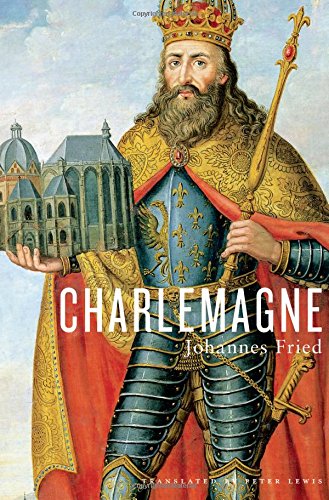
Charlemagne, by Johannes Fried

Ebook Free Charlemagne, by Johannes Fried
Discover the trick to enhance the lifestyle by reading this Charlemagne, By Johannes Fried This is a kind of publication that you require now. Besides, it can be your favored publication to review after having this publication Charlemagne, By Johannes Fried Do you ask why? Well, Charlemagne, By Johannes Fried is a publication that has different particular with others. You might not have to know which the author is, just how prominent the job is. As smart word, never ever judge the words from who speaks, but make the words as your inexpensive to your life.
It can be one of your early morning readings Charlemagne, By Johannes Fried This is a soft file publication that can be got by downloading from on the internet book. As recognized, in this advanced era, technology will certainly relieve you in doing some activities. Even it is merely checking out the visibility of book soft file of Charlemagne, By Johannes Fried can be extra attribute to open up. It is not just to open up and save in the device. This moment in the early morning and other leisure time are to read the book Charlemagne, By Johannes Fried
Guide Charlemagne, By Johannes Fried will certainly always offer you favorable worth if you do it well. Completing guide Charlemagne, By Johannes Fried to review will not end up being the only goal. The objective is by obtaining the good value from guide until completion of the book. This is why; you need to find out more while reading this Charlemagne, By Johannes Fried This is not just how quickly you read a book and also not just has how many you completed guides; it is about exactly what you have gotten from guides.
Thinking about guide Charlemagne, By Johannes Fried to read is also required. You could pick guide based upon the preferred themes that you such as. It will involve you to enjoy checking out other publications Charlemagne, By Johannes Fried It can be additionally about the need that binds you to review the book. As this Charlemagne, By Johannes Fried, you could discover it as your reading book, even your favourite reading publication. So, find your favourite publication here as well as obtain the link to download and install the book soft file.
When Charlemagne died in 814 CE, he left behind a dominion and a legacy unlike anything seen in Western Europe since the fall of Rome. Distinguished historian and author of The Middle Ages Johannes Fried presents a new biographical study of the legendary Frankish king and emperor, illuminating the life and reign of a ruler who shaped Europe’s destiny in ways few figures, before or since, have equaled.
Living in an age of faith, Charlemagne was above all a Christian king, Fried says. He made his court in Aix-la-Chapelle the center of a religious and intellectual renaissance, enlisting the Anglo-Saxon scholar Alcuin of York to be his personal tutor, and insisting that monks be literate and versed in rhetoric and logic. He erected a magnificent cathedral in his capital, decorating it lavishly while also dutifully attending Mass every morning and evening. And to an extent greater than any ruler before him, Charlemagne enhanced the papacy’s influence, becoming the first king to enact the legal principle that the pope was beyond the reach of temporal justice―a decision with fateful consequences for European politics for centuries afterward.
Though devout, Charlemagne was not saintly. He was a warrior-king, intimately familiar with violence and bloodshed. And he enjoyed worldly pleasures, including physical love. Though there are aspects of his personality we can never know with certainty, Fried paints a compelling portrait of a ruler, a time, and a kingdom that deepens our understanding of the man often called “the father of Europe.”
- Sales Rank: #65820 in Books
- Brand: Peter Lewis Johannes Fried
- Published on: 2016-10-10
- Original language: German
- Number of items: 1
- Dimensions: 9.30" h x 1.80" w x 6.40" l, .0 pounds
- Binding: Hardcover
- 688 pages
- Charlemagne
Review
Charlemagne is relentless in the accumulation of detail and austerely comprehensive in its endnotes… This Charles the Great is unmistakably Karl der Grosse… Matching the mood of our times, blood-flecked Realpolitik and smoldering religious intolerance are very much to the fore… Few [Charlemagne biographies] capture so well the unlovely realities of Carolingian politics and the sheer technical difficulty of ruling a medieval empire in the absence of a state apparatus. (Michael Kulikowski Wall Street Journal 2016-11-21)
Fried is a retired professor of medieval history but also thoroughly contemporary, a gleeful debunker who spends many pages demonstrating that the relatively few ‘known facts’ about Charlemagne rest on shaky foundations…The biography offers a first-rate survey of the war-torn eighth century. (Brian Bethune Maclean’s 2016-11-19)
[A] big, immensely satisfying life of the semi-legendary medieval Frankish king Charlemagne…[and] expertly translated by Peter Lewis… Instead of a legend, Fried builds a convincingly three-dimensional portrait of a man―a complicated, forceful, often contradictory man… There has never been a Charlemagne biography to appear in English that comes close to matching this big book from Fried… Fried has come as close as we’re every likely to get to knowing the man. (Steve Donoghue Open Letters Monthly 2016-10-31)
In this splendid biography, Fried shows that Charlemagne remains a figure to be reckoned with even 12 centuries after his death. The book, excellently translated by [Peter] Lewis, is arranged by topic, rather than chronology. This format helps to clearly present a broad picture…This is a magisterial study of the life and times of the Frankish king who became the first Holy Roman Emperor. (Publishers Weekly 2016-08-29)
Johannes Fried has put forth a valiant effort in untangling the wheat from the chaff in Charles the Great’s life. Charlemagne is viewed as a flawed leader who cared about his kingdom and his religion, even if his approach could be questioned. An excellent view of a mysterious monarch. (Philip Zozzaro Seattle Book Review 2016-12-01)
For those who wish to grapple with Charlemagne’s life in its entirety, without false certainties, Fried’s book is the best choice. (Andrew Moravcsik Foreign Affairs 2017-03-01)
An engaging and delightful read. It is well placed to foster curiosity and shed light on a lesser known period of history and this ‘late dark-age’ king…Lewis’s translation of Fried’s work is successful in exposing a side of Charlemagne that most works do not. The translation provides English readers with a considered account of Charlemagne’s educational ideals, his relationship with Christianity and the Papacy and his attempts to construct a unified kingdom in something of an unstable world. The author creates a Charlemagne who tried his best to provide for his people in their physical lives as well as their afterlives…It is one of the most accessible and perhaps well-rounded accounts of Charlemagne currently available. (Sara Perley LSE Review of Books 2017-04-07)
About the Author
Johannes Fried was, until his retirement, Professor of Medieval History at the University of Frankfurt.
Most helpful customer reviews
26 of 29 people found the following review helpful.
The Charlemagne you only thought you knew
By Dick from New Hampshire
Writing a review of a 554 page history that upsets all I remembered about Charlemagne is a daunting task; hope I'm up to it.
I frequently buy books based on reviews in the Wall Street Journal. The WSJ reviewer nearly dissuaded me: He found the translation clumsy and "Germanic". I had visions of plowing through 500-600 pages of turbid prose, in which each word, each phrase, each clause was given an English translation.
Instead, I thought the translation was smooth, lucid, and flowing. You would have no trouble following it.
If you have read popular biographies of Charlemagne, you would imagine that this one would provide details of his wars, battles, and conquests. Instead, it mentions important events such as the defeat of the Saxons with only a few scattered sentences in several chapters. The loss at Roncesvalles gets even less.. So what did interest the warrior king?
1. The spread and practice of Christianity. Newly-conquered provinces were Christianized en masse, with death the punishment for recalcitrance. The situation was even worse in some regards in Francia: ignorant and apathetic clergy, corrupt versions of liturgical documents, heresy, the list goes on.
2. Education for the clergy, the nobility, and commoners. Charlemagne created first the court schools for the scions of the nobility and clergy; the graduates were deployed to cathedral and eventually manorial schools. Teaching correct Latin was an essential part of this. His 40-year reign provided ample time for learning to spread.
3. Rewriting liturgical documents--this time in correct Latin--permitted Masses and sermons to be conducted in the approved manner. First, however, corrupted texts needed to be identified, compared, and canonical versions created. The search went on throughout the Empire.
4. Training the clergy--higher and lower--in their duties and correcting errant performers. This was somewhat successful. Correcting the conduct of the magnates was not.
5. Achieving and maintaining good relations with the papacy. This had its ups and downs. However, Charlemagne was a devoted Christian and generally energetically supported the Pope.
6. Maintaining peace and prosperity throughout the realm. Charlemagne sympathized with the lot of the poor and unfree and tried to alleviate their hardships by providing food when necessary and price controls, his version of caritas.
7. Defending borders from invaders, for example, the Moors of Spain. The Vikings only became a real threat after his death.
I hope this brief summary conveys the major topics in Fried's 540 page opus. If you're interested in a detailed discussion of Charlemagne's career,
this may be the book for you.
0 of 0 people found the following review helpful.
Wonderfully educated speculation.
By J. P Spencer
While not a traditional biography, this is a fascinating piece of detective work. As Fried points out, we cannot really know or understand Charlemagne. He comes from times totally alien to us in every possible way and there are none of the biographical sources that a political figure from more recent times would have available. But Fried does a fabulous job of explicating what we can learn from the sources that are available and speculates convincingly on what that tells us. All of this is done in a brilliant text (credit for which at least in part must go to Fried's translator Peter Lewis.). This is not a story of knights and daring do, it's about the development of political, legal, and religious systems. But for those interested in very early European political history, I recommend this highly.
20 of 20 people found the following review helpful.
Detailed and Interesting; Emphasis on Deep Christian Roots of Europe
By Charles
“Charlemagne” is a rare sort of work—a satisfying biography about a historical figure about whom very little is directly known. The usual result from biography in such cases, as opposed to histories where a mostly hidden person figures merely in the greater context of his times, is the writing of fiction. Authors seem unable to resist ascribing specific thoughts and actions to their hidden biographical subjects. But in “Charlemagne,” the German historian Johannes Fried has accomplished the near-impossible, writing a biography of Charlemagne that tells us a great deal about the man, as well as plausible suppositions about him, without engaging in fiction and while clearly identifying that which we do not know.
Fried accomplishes this by describing everything around Charlemagne, using stated sources. The man is glimpsed in the lacunae, as well as from a very few direct bits of knowledge, such as marginal notes made by Charlemagne in writings by others. Fried extracts and conveys a great deal of knowledge from judicious use of official and semi-official chronicles and writings of the time. And Fried’s knowledge of the era is immense and precise; in this entire book I could not detect a single inaccuracy, or even over-confident statement (not that I’m an expert on this era, or a professional historian, but in most history books I detect at least a few errors, and anyway being a professional historian today probably inclines one to more errors, rather than fewer, due to the required ideological conformity).
This is not a book about battles, although those are certainly mentioned. It is fundamentally a book about the religious belief of Charlemagne and his times, and how those beliefs directly resulted in the actions Charlemagne took, which ultimately and directly created modern Europe. In our time, the way that religion suffused medieval Europe, in particular its ruling classes, is essentially incomprehensible. We are taught to think of religion as the enemy of modernity, not the spur towards modernity, as it was for Charlemagne. We are taught that kings and princes were not believers; they supposedly merely paid lip service to religion as the opiate of the people while cavorting about, unconcerned about their own souls, proto-Machiavellians all.
But this narrative is false, as even a casual reader of medieval history knows. As Fried relates, the atmosphere in which Charlemagne lived, worked and breathed was that of saving his own soul and that of as many other people as possible, in anticipation of his own death as well as the imminent End of Days. And he strove to save his soul not by vague good behaviors, as by adhering to a modern-type belief that God just wants us to do what makes us happy, but by performing constant hard concrete actions that God demanded of him, personally, and especially of him as king, for the belief was that on the Day of Judgment, the sins of all his people would be laid on the shoulders of their king.
Of course, by our standards some of those concrete actions were not in keeping with the Sermon on the Mount. Various northern German tribes, especially the Saxons, were converted at the point of the sword. Various other peoples were also on the receiving end of Charlemagne’s sword for one reason or another. And Charlemagne was hardly an angel—he killed or “disappeared” several of his relatives, including his nephews, and he put aside more than one wife, finally ending his life by keeping concubines instead in order to keep things simple. Fried spends quite a lot of time pondering, without deciding, how Charlemagne must have viewed his own chances of salvation. We cannot know his personality, but we can know that “Charlemagne’s principal concern, which permeated his every action, was for the Christian faith and the Church.” The man himself may have fallen short of Christian virtue on many occasions, but that hardly distinguishes him from every other Christian who has ever lived—it is his legacy in the structure and thought of Europe that distinguishes him, and that legacy is a Christian legacy, through and through.
Fried begins by setting the scene, in a few paragraphs vividly conveying how very different the European world of 748 (roughly Charlemagne’s birth) was. Population was thinly spread; forests were everywhere. The Vatican did not exist; nor did Venice as we conceive it; nor really any other European city. None of the cathedrals or castles we associate with the Middle Ages stood. The rhythms of life were totally different; even the educated were only beginning to rediscover traditional modes of thought and reasoning. “The mountain summits of the Alps were shrouded in solitude and silence . . . . The world was a placid place, time was not precious, and no one except fugitives from the law was hounded.”
Fried relies heavily on a few basic sources. One is the “Life of Charlemagne,” written shortly after Charlemagne’s death by Einhard, who knew Charlemagne his entire life and was a courtier and scholar. This book was written in praise of Charlemagne and in implicit criticism of his successor as King of the Franks, Louis I, “The Pious” (whom Fried does not like at all). A second is the “Royal Frankish Annals,” official annual summaries of Carolingian rule, begun prior to Charlemagne’s birth and continued until well after his death, over which it is believed Charlemagne personally exercised control. Fried views these as extremely valuable, but propagandistic by their nature, and therefore requiring close reading and analysis in order to obtain truth. A third, though highly dubious in its accuracy, is a book of anecdotes written some decades later by the monk Notker (called the Stammerer). Other works also feature occasionally, such as those of the contemporary Lombard historian Paul the Deacon; the “Earlier Annals of Metz,” compiled under the supervision of Charlemagne’s trusted sister, Gisela, the abbess of a convent; and specific theological works with a political overtone which Charlemagne personally commented on and approved. In addition, the writings of key figures of the Carolingian Renaissance, especially the rivals Alcuin of York and Theodulf the Visigoth, lend color and depth to Fried’s narration. But among all these, there is no self-portrayal of Charlemagne himself, not even a hint; we can only surmise what he thought of himself and his world.
Fried organizes his biography roughly chronologically, and within that overall scheme focuses chapters on particular themes. So, for example, the first chapter is “Boyhood,” discussing exactly that; the next chapter is “The Frankish Empire and the Wider World.” As to Charlemagne’s boyhood, Fried sets the stage by describing the life and times of the early Carolingians, focusing naturally enough on Charlemagne’s father, Pepin the Short. Charlemagne was highly educated for a layman of the time, speaking Latin, engaging in dialectics, and, of course, receiving extensive religious and, to a lesser extent, theological education. Throughout his life, Charlemagne maintained and expanded a sizeable library, and constantly strove to increase the learning of himself and his court.
Here Fried introduces one theme that runs throughout his biography—the perceived imminence to all people of that time and place of the Second Coming and the Last Judgment, “the subject of vivid and terrifying portrayals.” At the same time, this was a world of constant warfare, greed and struggle among the elite Franks for status and power—not least the Carolingian monarchs themselves, of whom Pepin was only the first, having formally deposed the Merovingian monarchs to whom the Carolingians supposedly owed homage, as Mayors of the Palace. Fried also here introduces a second theme, Charlemagne’s support for and intertwining with a powerful papacy—Charlemagne first met the Pope (Stephen II) at the age of six, during negotiations between his father and the Pope for Pepin’s needed support against the Lombards in northern Italy, in a theatrical spectacle that Fried reasonably believes made a major impression on the young Charlemagne.
Turning next to “The Frankish Empire and the Wider World,” Fried notes that while the Franks were very much aware of the larger world, including not only Italy but also Byzantium and the Middle East, they had little interest in it, even when visiting abroad, although Charlemagne did exchange envoys with Harun al-Rashid, caliph in Baghdad (who sent Charlemagne an elephant). Nor did they have much interest in Scandinavia, even when the Vikings showed up to cause trouble. Even internally, Carolingian culture did not engage in “attempting a comprehensive abstraction to try to gain a spatial awareness of the whole empire or of individual sections of it”—they traveled, and they found more efficient ways to travel, but they simply did not view space as we do. Here Fried introduces a third theme of his work—the varied and often-contentious relationship between the Carolingians and the Byzantines.
Fried returns the focus in the next chapter to Charlemagne, “The Warrior King.” He was about twenty when his father died; Charlemagne then began a never-ending series of wars, against enemies both external (the Saxons; the Lombards who opposed the Pope; the Avars; and the Muslim occupiers of Spain, against whom he had little success) and internal (his brother, Carloman, to whom Pepin had given half the empire; his cousin, Tassilo III of Bavaria; and his eldest son, Pepin the Hunchback). Early on, he also cemented his relationship with the Pope, visiting Rome for some time and cutting a deal with the pope (then Hadrian I), in which promised support to the Pope (though the degree and details varied depending on who was doing the telling, along with who was said to be in charge), in exchange for increased legitimacy. The spurs for Charlemagne’s wars were mixed, of course, but as Fried says, “It is certainly the case that the cause of religion legitimized each of his wars—not least in Charlemagne’s own eyes. Every war he entered into was either accompanied or followed by measures paying homage to God and His saints. People were meant to gain the greatest benefit from his conflicts: future salvation and a hope of eternal bliss.” Moreover, conquered territories benefited: “Christianity introduced literacy and methodically controlled rationality into countries that until then had not had any form of written culture.” This is jarring to modern ears; many of us do not want to hear such things, either that religion matters or that some cultures are superior to others, although both things are indisputably true. But understanding this way of thinking is key to both understanding Charlemagne and his times, and our times, in that there are many areas of the world where religions that believe God holds us to account are still mainsprings of human action.
Later chapters discuss “Power Structures,” which discusses less how the nobility was structured and more about the economic structures that underlay noble power, including agriculture, the manorial system, estate management and so on, followed by “The Ruler,” which more narrowly discusses its subject. As others have also noted, expansion of “modern,” scientific farming and land reclamation was led by monasteries, because monks tended to have a much longer, corporate view of land management. Here Fried introduces his fourth theme—Charlemagne’s constant and unevenly successful efforts to centralize management of his empire, using various devices, including written ordinances, or “capitularies” (the “Admonitio generalis” and others) distributed throughout the empire, as well as roaming royal envoys sent to observe and report, and also to deliver specific instructions. Charlemagne’s focus was not on maximizing his return, although money was important, since warfare cost money. Rather, it was on ending disputes and ensuring and spreading justice for all, from the lowest to the highest—because this was dictated by God, and failure to maintain a constant focus on justice would have imperiled Charlemagne’s soul, for justice was one key demand placed on a Christian monarch, together with peace and (Christian) unity.
To these ends Charlemagne also expanded and formalized the system of education and literacy, including by spreading Latin and therefore modes of thought impossible in Frankish, thus laying the groundwork for the later full blossoming of European thought. Foreigners were welcomed in this effort. For example, Alcuin’s “On Rhetoric,” addressed to Charlemagne, was one of the formative documents re-establishing the “reason-oriented Western scholarship” that has made our world what it is today. “The practice of classical rhetoric was education and the beginning and foundation of all scholarship. Not only did it attest the capacity for reason, but also, much more than that, it represented humanity, a rationality-bound human dignity wrested from an animal-like existence.”
This key analysis, sadly, shows why modern public discourse, focused not on reason and human improvement but on the alleged independent validity of emotions and the supposed ubiquity of oppression, leads us toward that animal-like existence, rather than away. Instead of elite-led reason driving a search for objective excellence, we are forced by our elites, the new priests of Baal, to worship a coarse, false reality, where elastic concepts whose only common denominator is opposition to excellence, today “diversity” and “inclusion,” tomorrow doubtless some other set of banal catchphrases, are substituted for actual pursuit of real high human values. The only resulting certainty is our degradation. We like to think that in Charlemagne’s time people saw less clearly, and in some ways perhaps they did, but in many ways, they saw more clearly than us.
Another chapter discusses “The Royal Court” in detail, including the architecture of Charlemagne’s palace complexes (in Aix, for example, designed to evoke Roman precedents and power), and the important role of women in general, who among the nobility had “far-reaching authority,” as well as Charlemagne’s daughters, who were not married off for political gain and instead engaged in various unmarried affairs with men of the court, bearing children as a result, all without provoking their father’s wrath. Two other chapters discuss the run-up to, and the results of, Charlemagne’s deciding to assume the title of Emperor, in opposition to Byzantine claims (and exacerbating already-existing theological differences with them) and in tension with papal claims, though internal Byzantine and papal turmoil led to quick acceptance by both of the new order. Much of Charlemagne’s rule as Emperor, after 800 A.D., was occupied with theological disputes, again in service of Charlemagne’s self-perceived critical role of contributing to Christian unity, along with somewhat frantic and unavailing efforts to bring justice to the land before both Charlemagne’s impending death and the possible imminent Apocalypse.
Finally, Charlemagne died, about age sixty-five, both expecting and prepared for death, and having spent a great deal of effort and trouble to bring to his empire Christianity, learning, literacy, peace, justice, and old modes of learning made new again. Fried closes with an “Epilogue,” discussing not only Charlemagne’s impact in reversing centuries of cultural dissolution in the West, and in achieving sound innovation while pursuing restoration, but also the many uses, not a few pernicious, to which his name and legacy have been put in succeeding centuries.
The level of detail in this book could be overwhelming, and probably is if you are not keenly interested in the subject matter. The English translation, while not gripping, reads well, seems precise and does not alienate the reader. Aside from the straight history, the book contains many interesting facts I did not know at all—for example, Charlemagne gave Pope Leo III a gemstone cross, which sounds not exceptional, but Fried explains “gemstone crosses traditionally allude to the Second Coming of Christ to judge the world, and represent the future, heavenly Jerusalem,” a fact that adds considerable flavor and color to an otherwise mundane event. Reading this book, immersing myself in a different time, was very enjoyable, and very educational.
Charlemagne, by Johannes Fried PDF
Charlemagne, by Johannes Fried EPub
Charlemagne, by Johannes Fried Doc
Charlemagne, by Johannes Fried iBooks
Charlemagne, by Johannes Fried rtf
Charlemagne, by Johannes Fried Mobipocket
Charlemagne, by Johannes Fried Kindle

Tidak ada komentar:
Posting Komentar